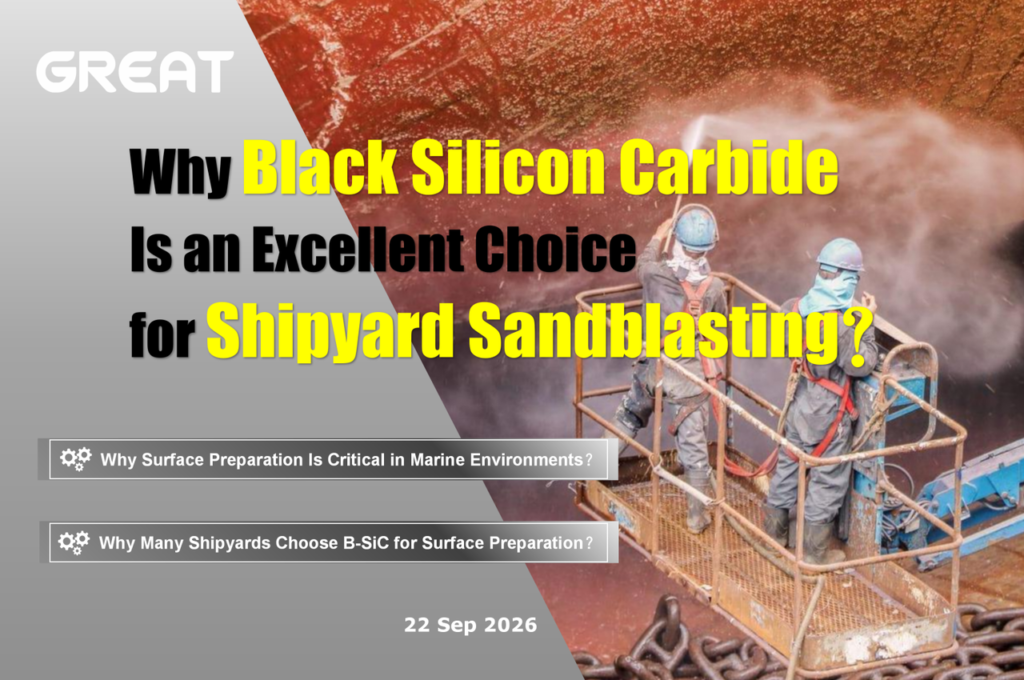
Selecting the correct abrasive grit size is one of the most important decisions in any sandblasting project. While both Black Silicon Carbide F46 and F60 are widely used for surface preparation, they are designed to achieve different results.
Understanding the differences between these two grit sizes can help improve surface quality, reduce processing time, and optimize coating performance.

What Is the Difference?
Both F46 and F60 are manufactured from high-purity Black Silicon Carbide and feature the same sharp, angular particle shape. The primary difference lies in particle size.
F46 is coarser and delivers more aggressive cutting action, making it suitable for faster material removal and creating a medium surface profile.
F60, on the other hand, is finer. It removes contaminants more gently while producing a smoother and more uniform finish. This makes it ideal for applications where appearance and surface consistency are critical.
When Is F46 the Better Choice?
F46 is recommended when the workpiece requires efficient cleaning and a stronger anchor profile before coating.
Typical applications include:
- Removing medium rust and oxidation
- Cleaning welded steel structures
- Preparing structural steel for protective coatings
- Heavy machinery components
- Industrial fabrication
- Thermal spray surface preparation
Because of its higher cutting efficiency, F46 is often selected when productivity is the primary concern.

When Should You Choose F60?
F60 is better suited for applications that require finer surface preparation or lower surface roughness.
Typical applications include:
- Stainless steel finishing
- Aluminum alloy components
- Precision-machined parts
- Decorative metal products
- Powder coating preparation
- Fine paint systems
- Mold cleaning and maintenance
- Surface finishing before polishing
Its smaller particles reduce the likelihood of excessive surface damage while still providing excellent cleaning performance.
Surface Finish Comparison
The difference between F46 and F60 is most noticeable in the surface profile they create.
| Feature | F46 | F60 |
| Particle Size | Medium | Medium-Fine |
| Cutting Speed | Higher | Moderate |
| Surface Roughness | Medium | Fine |
| Material Removal | Faster | More Controlled |
| Coating Preparation | Heavy-duty coatings | Decorative and fine coatings |
| Precision Components | Good | Excellent |
For projects requiring maximum coating adhesion on heavy steel structures, F46 is often the preferred option. For parts where appearance, dimensional accuracy, or a smoother finish is more important, F60 generally delivers better results.
Which Industries Prefer F60?
Because of its finer finish, Black Silicon Carbide F60 is commonly used in:
- Automotive manufacturing
- Aerospace component production
- Stainless steel fabrication
- Medical equipment manufacturing
- Precision engineering
- Electronics equipment
- Decorative metal finishing
- Powder coating production lines
These industries value consistency, cleanliness, and surface quality as much as blasting efficiency.
How to Select the Right Grit Size?
When choosing between F46 and F60, consider the following factors:
- Material type
- Thickness of rust or coating
- Required surface profile
- Final coating system
- Production efficiency
- Surface finish requirements
In many manufacturing facilities, both grit sizes are used together. F46 is selected for initial surface preparation, while F60 is used when a finer finish or higher surface quality is required.
Conclusion
Although Black Silicon Carbide F46 and F60 share the same outstanding hardness and sharp cutting edges, they serve different purposes.
F46 is the preferred choice for efficient cleaning and medium surface profiles, while F60 excels in precision surface preparation and applications requiring smoother finishes.
Choosing the appropriate grit size not only improves blasting performance but also enhances coating adhesion, product appearance, and overall manufacturing efficiency.