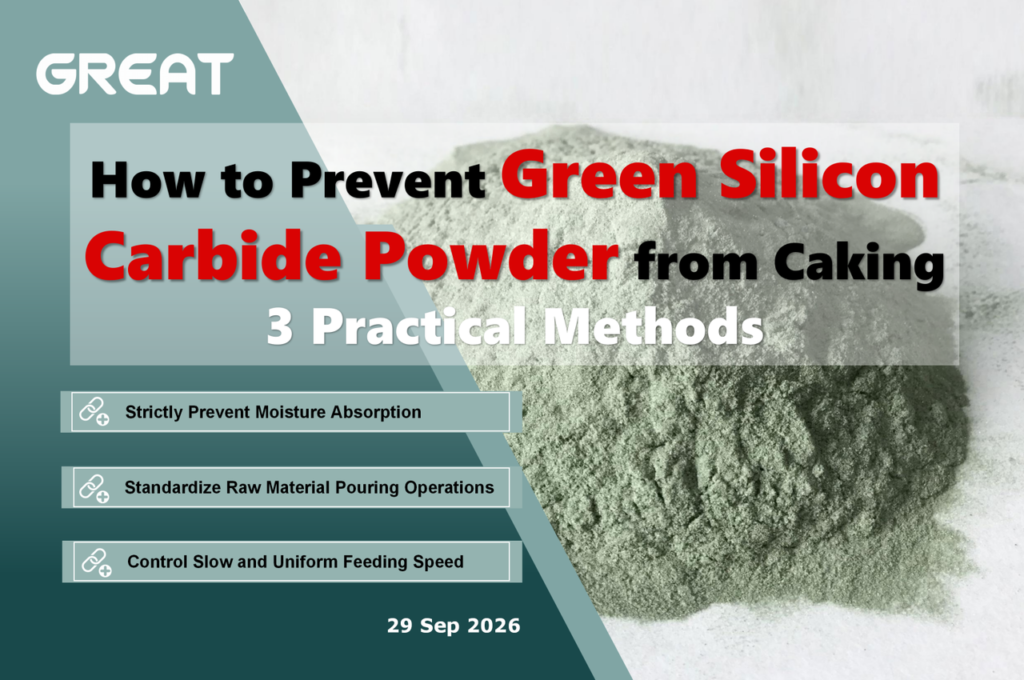
Green silicon carbide powder is prone to caking during production, packaging, transportation, and storage due to its fine particles. The most effective ways to prevent caking are: keeping the powder sealed and dry, following proper pouring procedures, and controlling a slow, uniform feeding speed.
Why Does Green Silicon Carbide Powder Cake So Easily?
Green silicon carbide powder is a high-performance industrial abrasive known for uniform particle size distribution, high purity, complete crystal structure, high hardness, and excellent thermal conductivity. It also offers outstanding self-sharpening performance, strong cutting ability, stable chemical properties, and great thermal shock resistance, which is why it is widely used in grinding, polishing, and precision processing.
But there is a catch. Because the particles are so fine, green silicon carbide micro powder tends to cake under pressure during production, packaging, transportation, and storage. Once that happens, powder dispersion drops, slurry stability suffers, and final processing quality takes a hit. The good news is that most caking problems can be avoided with standardized operation and proper management.
Strictly Prevent Moisture Absorption
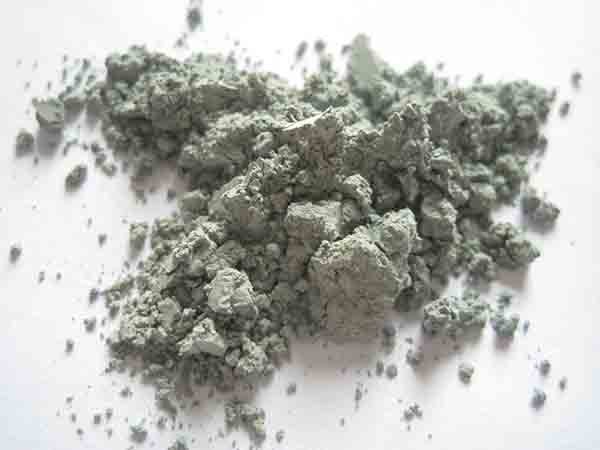
Green silicon carbide micro powder has strong hygroscopicity. It absorbs moisture from the air easily, and that moisture forms agglomerations. Damp caking reduces powder dispersibility, lowers slurry viscosity, and creates false particles and accumulated masses in the slurry. These abnormal agglomerates directly weaken cutting efficiency and processing surface quality.
The fix is simple but must be consistent: never leave the micro powder exposed to open air for long periods. Sealed storage is required in every link after production, so the powder stays dry and its physical properties remain stable.
Standardize Raw Material Pouring Operations
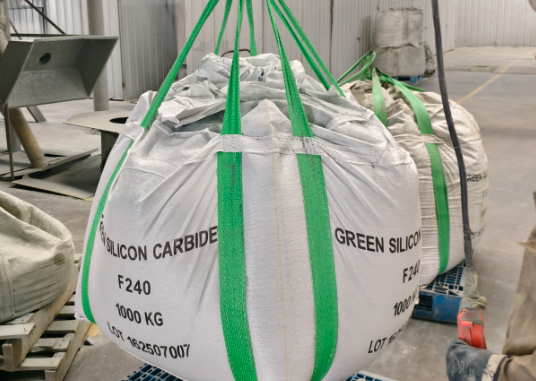
Improper dumping is another major cause of caking. Strict operating procedures should be followed during material feeding and slurry preparation.
- Before feeding, remove floating dust and impurities from the bag surface and bag mouth to avoid foreign matter mixing into the raw material.
- Inspect each bag carefully. Damaged or leaking packaging bags must be stored separately and must not be used, to prevent damp and contaminated powder from entering production.
Control Slow and Uniform Feeding Speed
Rapid dumping leads to powder sedimentation and bottom caking. Once agglomerates form, they are difficult to stir evenly, and the ingredient ratios become inconsistent. The standard feeding speed is 2.5 to 3 minutes per bag. Slow, uniform pouring ensures full powder dispersion, maintains accurate slurry proportion, and keeps cutting and polishing performance stable.
FAQ: Green Silicon Carbide Powder Caking
Why does green silicon carbide powder cake?
Because of its fine particles and strong hygroscopicity, it absorbs moisture from the air and cakes under pressure during storage, transportation, and feeding.
How do you store green silicon carbide micro powder?
Keep it sealed at all times after production. Avoid long exposure to open air, and store it in a dry environment to maintain stable physical properties.
What is the correct feeding speed for green silicon carbide powder?
The standard is 2.5 to 3 minutes per bag. Slow, uniform pouring prevents sedimentation and bottom caking.
Conclusion
Moisture-proof storage and standardized dumping operations are the key measures to prevent green silicon carbide micro powder from caking. Put these methods into practice consistently, and you will keep the powder’s excellent dispersion and original performance intact, ensuring stable and consistent processing results.